
Single Energy X Ray Baggage Scanner
If you want your security checkpoint to be faster, more reliable, and more professional, a Single Energy X Ray Baggage Scanner is one of the most practical solutions for screening bags, parcels, and hand luggage—without opening them. It’s widely used in places where visitor flow is high and security teams need quick visual inspection with a clear X-ray image.
What is a Single Energy X Ray Baggage Scanner?
A Single Energy X Ray Baggage Scanner is a security screening machine that generates an X-ray image using one energy range (single-energy imaging) to inspect baggage and parcels. The system helps operators identify suspicious items by showing different densities (light/dark contrasts) inside the bag—without physically unpacking it. Many manufacturers describe these machines as suitable for scanning briefcases, parcels, hand luggage, and small packages in airports, stations, government facilities, logistics areas, and more.
How single-energy imaging differs from dual-energy
In simple terms:
- Single Energy X-ray (this page): focuses on density-based imaging (clear grayscale/contrast viewing).
- Dual Energy X-ray: uses two energy levels to better support material discrimination (often color-based categories like organic/inorganic/metal in the image). Many security guides explain that the key difference is the type of image produced and how materials are separated visually.
Single-energy scanners are popular because they often deliver:
- Strong value for money
- Easier operation and training
- Reliable screening for general public entry points
- Faster deployment for standard checkpoints
How a Single Energy X Ray Baggage Scanner Works
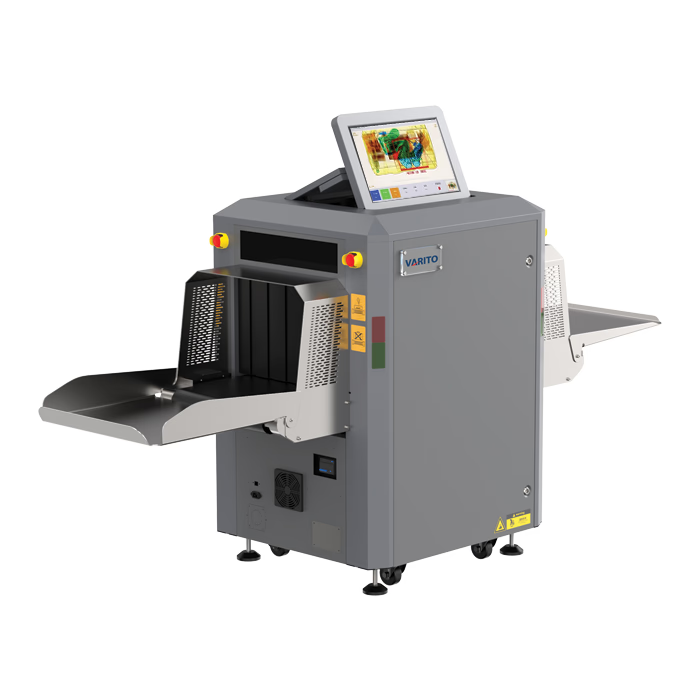
A typical baggage X-ray scanner includes:
- Conveyor belt + tunnel
- The bag moves through a shielded tunnel at a steady speed.
- The bag moves through a shielded tunnel at a steady speed.
- X-ray generator
- Emits X-rays through the item (inside the tunnel).
- Emits X-rays through the item (inside the tunnel).
- Detector array
- Captures how much X-ray is absorbed by different objects.
- Captures how much X-ray is absorbed by different objects.
- Imaging software
- Converts signals into a clear X-ray image on the operator monitor.
- Converts signals into a clear X-ray image on the operator monitor.
Because different materials absorb X-rays differently, the operator sees varied intensities and shapes—helpful for detecting restricted items, concealed objects, or unusual structures inside the luggage.
Where Single Energy X Ray Baggage Scanners are Used
Single-energy scanners are commonly installed at:
- Airports & domestic terminals (entry screening, staff access points)
- Railway & metro stations (platform entry, station gates)
- Government offices & embassies
- Courts, prisons, and secure facilities
- Hotels, shopping malls, exhibition halls
- Factories, warehouses, and logistics hubs
- Schools, hospitals, and event venues
The reason is simple: these places need non-invasive inspection that balances speed, visibility, and practical security coverage.
Key Benefits of X Ray Baggage
1) Faster screening with less manual checking
Instead of opening bags one by one, security staff can inspect contents visually in seconds—reducing queues and improving visitor experience.
2) Better risk control at entrances
A scanner increases deterrence and helps prevent incidents by detecting suspicious items before they pass the checkpoint.
3) Professional security image for your facility
For corporate buildings, hotels, and public venues, an X-ray checkpoint signals a serious security standard.
4) Cost-effective solution for standard checkpoints
Single-energy is often chosen when the environment needs strong inspection but doesn’t require advanced dual-energy material classification for every lane.
Common Tunnel Sizes and Capacity
When buyers search “X Ray Baggage Scanner,” they usually compare tunnel size and load capacity first.
Popular tunnel size naming often looks like:
- 5030 (approx. 500mm width × 300mm height class)
- 6040, 6550, 8065, 10080 (larger categories for bigger items)
You’ll see listings showing models with tunnel sizes like 650(W) × 500(H) mm and similar configurations, along with conveyor speed and load ratings.
How to choose the right size
- Office/School/Small venue: 5030 or 6040 class
- Station/Hotel/Mall: 6040 or 6550 class
- Airport/High throughput lanes: 6550 / 8065 / larger (depending on baggage type)
Core Features of X Ray Baggage
High-clarity X-ray imaging
- Clear contrast image for fast decision-making
- Zoom, pan, and image enhancement modes (typical in modern systems)
Conveyor performance
- Stable belt movement supports consistent imaging
- Many product listings show conveyor speed around 0.22 m/s for common baggage scanners.
Penetration and resolution
Listings commonly mention:
- Wire resolution (e.g., 40 AWG shown in some product specs)
- Steel penetration (varies by model, generator power, and configuration)
Operator-friendly software tools
- Image recall & storage (useful for audits)
- Threat image projection (TIP) in some systems (training support)
- Alarm/marking tools, pseudo-color modes (depending on model)
Durable body & checkpoint-ready design
- Rugged frame for daily public use
- Easy roller/maintenance panel access for service teams
Safety and Compliance
Professional buyers care about safety, shielding, and compliance. Good pages explain safety without fear-mongering.
- In the United States, cabinet X-ray systems must meet radiation safety performance standards; FDA notes a limit of 0.5 milliroentgens in one hour at any point 5 cm from the external surface for cabinet systems.
- Health Canada’s guidance on baggage X-ray systems emphasizes keeping radiation risks negligibly low, aligning with radiation protection principles and proper procedures.
Best practice message (safe + professional):
- Use trained operators
- Follow local regulations
- Perform periodic safety checks/calibration
- Maintain shielding integrity and curtains
This builds E-E-A-T style trust and helps conversion.
How to Choose the Best Single Energy Baggage Scanner
Step 1: Confirm what you scan most
- Hand luggage only?
- Parcels and cartons?
- Backpacks + cabin bags?
- Occasional big items?
Step 2: Choose the right tunnel size
Pick based on your largest typical item, not the smallest.
Step 3: Match throughput needs
If you have rush hours (train station entry, event gates), prioritize:
- Stable conveyor performance
- Fast image processing
- Larger tunnel size to reduce re-scans
Step 4: Select software usability
Your best machine is the one operators can use confidently:
- Clear UI
- Fast zoom/enhance
- Quick training mode
Step 5: Service & spare parts matter
For Bangladesh and similar markets, the “best” choice often comes down to:
- Local support
- Warranty terms
- Availability of belt/curtain/spares
- Installation and operator training
Why Buy from a Professional Supplier
To compete on Google for “X Ray Baggage Scanner,” your page should clearly communicate commercial trust signals, such as:
- Genuine products with serial verification
- Installation and commissioning support
- Operator training included
- Warranty and after-sales service
- Spare parts availability
- Consultation to select the correct tunnel size
These points align with what decision-makers care about: risk reduction + uptime + accountability.
Final Thought
A Single Energy X Ray Baggage Scanner is the smart choice for organizations that need reliable, fast, and cost-effective entry screening. It improves security without slowing your operations—and it provides a professional checkpoint experience for airports, stations, offices, venues, and logistics sites.