

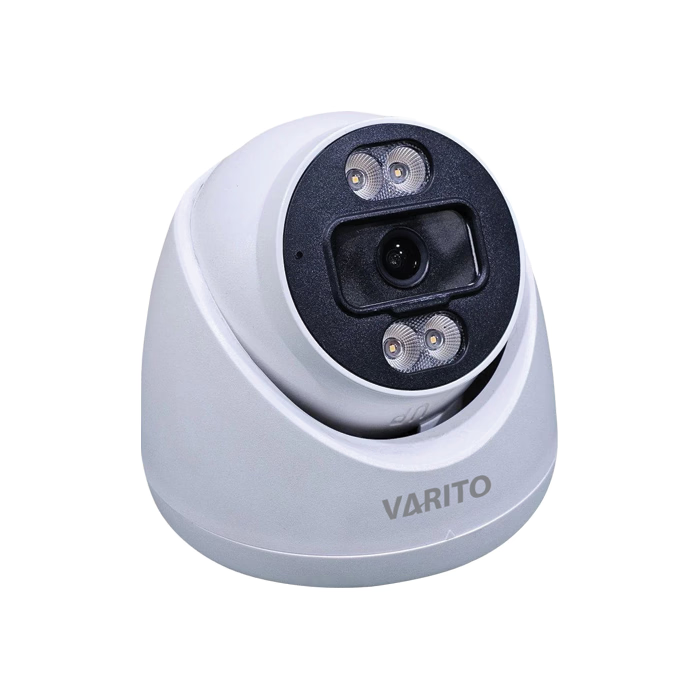
AI Series Surveillance
AI is changing how modern security teams monitor, detect and respond. Traditional CCTV systems record everything but they often create too many false alarms, too much manual searching, and too many missed moments when operators are busy. AI Series Surveillance solves these problems by adding AI-powered video analytics directly inside cameras (edge AI) and/or inside recorders (AI NVRs), so the system can automatically identify meaningful events like human or vehicle intrusion and filter out irrelevant motion such as rain, leaves, shadows, or animals.
Many major surveillance brands describe their AI product lines in exactly this way: AI-driven systems focus on human/vehicle classification to reduce false alarms and improve efficiency.
What is AI Series Surveillance?
AI Series Surveillance refers to a category of CCTV/IP video security products typically AI cameras, AI NVRs, and AI VMS features—that use machine learning/deep learning to analyze video in real time. Instead of only recording footage, AI Series Surveillance can:
- Detect and classify objects (commonly humans and vehicles)
- Trigger smarter alarms (intrusion, line crossing, perimeter breach)
- Reduce false alarms caused by non-threat motion (rain, foliage, insects, lighting changes)
- Speed up investigation with intelligent search
In practice, AI Series Surveillance is usually delivered in two ways:
1) Edge AI (AI inside the camera)
The camera itself runs analytics and sends events/metadata.
2) Recorder/Server AI (AI inside NVR/VMS)
The recorder/server runs analytics on incoming streams (or enhances camera analytics).
Some industry explanations of AI security cameras describe them as devices that analyze video in real time, can differentiate between humans/vehicles, and help reduce false alarms.
Why AI Series Surveillance
1) Fewer false alarms, better focus
False alarms waste time and cause “alarm fatigue.” AI classification helps teams focus on real targets. Hikvision explicitly notes that AI can minimize false alarms triggered by animals, falling leaves, heavy rain, and other moving objects, by focusing on humans and vehicles.
2) Faster incident response
AI can notify guards/operators instantly when a defined rule is triggered (intrusion into a restricted area). That means faster response and reduced damage/loss.
3) Faster video search and investigation
Instead of scrubbing through hours of footage, AI systems can filter by event type (human/vehicle), making investigations dramatically faster.
4) Better ROI from your cameras
With AI, you get more value from the same camera infrastructure: proactive alerts, better evidence, and improved operations.
How AI Series Surveillance Works
AI surveillance is best understood as a pipeline:
- Video capture (camera lens + sensor)
- Video processing (image enhancement, WDR, low-light tuning)
- AI inference (object detection/classification, behavior rules)
- Event triggers (intrusion, line crossing, loitering, tampering)
- Actions (alarm, push notification, recording bookmark, relay output)
- Storage and review (NVR/VMS with event-based playback/search)
Many AI product families highlight this “detect humans/vehicles and alert” workflow as their main value.
Core AI Features in AI Series Surveillance
When customers search “AI Series Surveillance,” they usually want these features. Your product category page should cover them clearly.
Human & Vehicle Detection
This is the most common AI function in mainstream “AI series” lines because it produces immediate benefits (fewer false alarms, smarter alerts).
Perimeter Protection
Common rule types:
- Line crossing detection
- Intrusion detection
- Region entrance/exit
Many AI camera product specs list these “smart event” capabilities as key features.
Smart Motion Detection (reducing false triggers)
AI systems can filter motion events so that only relevant targets trigger alarms. Dahua’s materials highlight this as a core idea: focus on real targets and reduce false alarms.
Camera Tampering / Scene Change Alerts
AI series systems often include alarm events like motion and tampering detection as part of their event framework. ONVIF Profile T, for example, includes support for alarm events such as motion and tampering detection, and includes metadata streaming as mandatory for devices.
Smart Search / Target Search
Some AI ecosystems promote faster post-event search (e.g., find people/vehicles quickly).
AI Series Surveillance Product Types
1) AI IP Cameras
These are network cameras with embedded AI. Typical AI camera categories include:
- AI dome cameras
- AI bullet cameras (perimeter)
- AI turret cameras
- AI PTZ cameras (wide-area, tracking)
- AI panoramic/multi-sensor cameras (large coverage)
Best for: entrances, perimeters, corridors, warehouses, parking areas, and any location where alarms matter.
2) AI NVR (AI Recorder)
An AI NVR can:
- Record multiple IP cameras
- Manage alerts and event playback
- Sometimes run additional analytics (depending on brand/model)
Many AI series strategies include AI in both cameras and recorders to maximize detection accuracy and usability.
3) AI VMS / Intelligent Video Servers
For larger deployments, organizations may use intelligent video servers or VMS platforms that can support large numbers of channels and AI features. For example, Dahua’s Intelligent Video Surveillance Server product pages highlight high channel counts and AI functions such as IVS, face recognition, metadata, and more (capabilities vary by model and camera type).
AI Series Surveillance vs Standard IP Surveillance
Standard IP Surveillance
- Records video
- Basic motion detection (often high false alarms)
- Manual monitoring and searching
AI Series Surveillance
- Detects and classifies targets (human/vehicle)
- Smarter alarms with reduced false triggers
- Faster search and better incident response
- Often supports metadata/events and structured notifications
ONVIF and Interoperability for AI Series Surveillance
When buyers mix brands (different cameras + NVR + VMS), compatibility becomes critical.
ONVIF Profiles help explain interoperability by defining a fixed set of features for devices and clients.
Two profiles are especially relevant for modern AI-driven IP video systems:
ONVIF Profile T
Profile T is designed for IP-based video systems and supports H.264/H.265, imaging settings, and alarm events like motion and tampering detection. It also includes metadata streaming as a mandatory feature for devices.
Why this matters for AI Series Surveillance: metadata + standardized events help systems integrate more smoothly across devices and clients.
ONVIF Profile M
Profile M is discussed in the context of analytics/metadata (smart analytics capabilities and metadata filtering/streaming/querying are commonly associated with Profile M).
Category-page tip: If your AI cameras and recorders support relevant ONVIF profiles, mention it buyers often search “ONVIF AI camera” or “ONVIF NVR AI.”
Key Benefits of AI Series Surveillance for Businesses
Retail stores & shopping malls
- Human/vehicle intrusion alerts after hours
- Reduce false alarms from signage reflections or lighting changes
- Faster incident review (theft, disputes)
Factories & warehouses
- Perimeter intrusion alerts for restricted zones
- Vehicle movement monitoring in loading areas
- Safer operations through better visibility
Corporate offices & commercial buildings
- Smart alerts at entrances and parking areas
- Better visitor safety and compliance monitoring
- Professional security reporting
Residential and apartment complexes
- Reduce nuisance alerts (cats, rain, tree movement)
- Smarter entry monitoring and notifications
- Better evidence when incidents occur
How to Choose the Right AI Series Surveillance System
This section converts visitors into inquiries. Keep it practical.
Step 1: Define your goal
- Perimeter intrusion prevention?
- Entry monitoring?
- Vehicle gate security?
- Warehouse safety and theft prevention?
Step 2: Choose AI at the right place
- If you want higher accuracy and immediate classification: choose edge AI cameras.
- If you want centralized control and analytics management: choose AI NVR / VMS.
Many real deployments use both.
Step 3: Pick resolution + lens based on distance
AI is not magic—if the target is too small in the frame, detection becomes harder.
- Wide lens = broad coverage, but smaller targets
- Narrower lens = better detail at distance
Step 4: Check night performance and lighting
AI performance depends on usable image quality. Prioritize:
- IR night vision quality
- WDR for backlight scenes (gate/entrance)
- Proper camera placement (avoid glare)
Step 5: Confirm recording and alert workflow
Ask:
- Do you want 24/7 recording plus AI events?
- Event-based recording to save storage?
- Do you need push alerts to phones?
Step 6: Validate compatibility
If you plan to mix cameras/NVR/VMS, prioritize:
- ONVIF compatibility (Profile T; and analytics metadata where relevant)
- Testing one camera with your recorder before full deployment
Installation Tips for AI Series Surveillance
A strong category page should include a simple “best practice” checklist:
- Do a site survey (lighting, distance, blind spots)
- Mount cameras at the correct height and angle
- Avoid pointing cameras directly at headlights or strong reflections
- Segment CCTV network/VLAN where possible
- Set detection zones carefully (avoid roads/trees if not needed)
- Calibrate sensitivity and object size rules
- Configure alert escalation:
- local alarm (siren/light)
- mobile push notification
- control room display
Cybersecurity and Privacy Notes for AI Surveillance
Because AI cameras and NVRs are network-connected:
- Change default passwords
- Use unique credentials and role-based access
- Keep firmware updated (cameras + recorder)
- Limit remote access to secure methods
- Store recordings securely and define retention policies
This builds trust for enterprise buyers and improves your E-E-A-T signals.
Final Thought
AI Series Surveillance is the modern upgrade from “record-only CCTV” to smart, proactive security. By using AI to classify targets, especially humans and vehicles these systems reduce false alarms, improve response speed, and make investigations faster.